
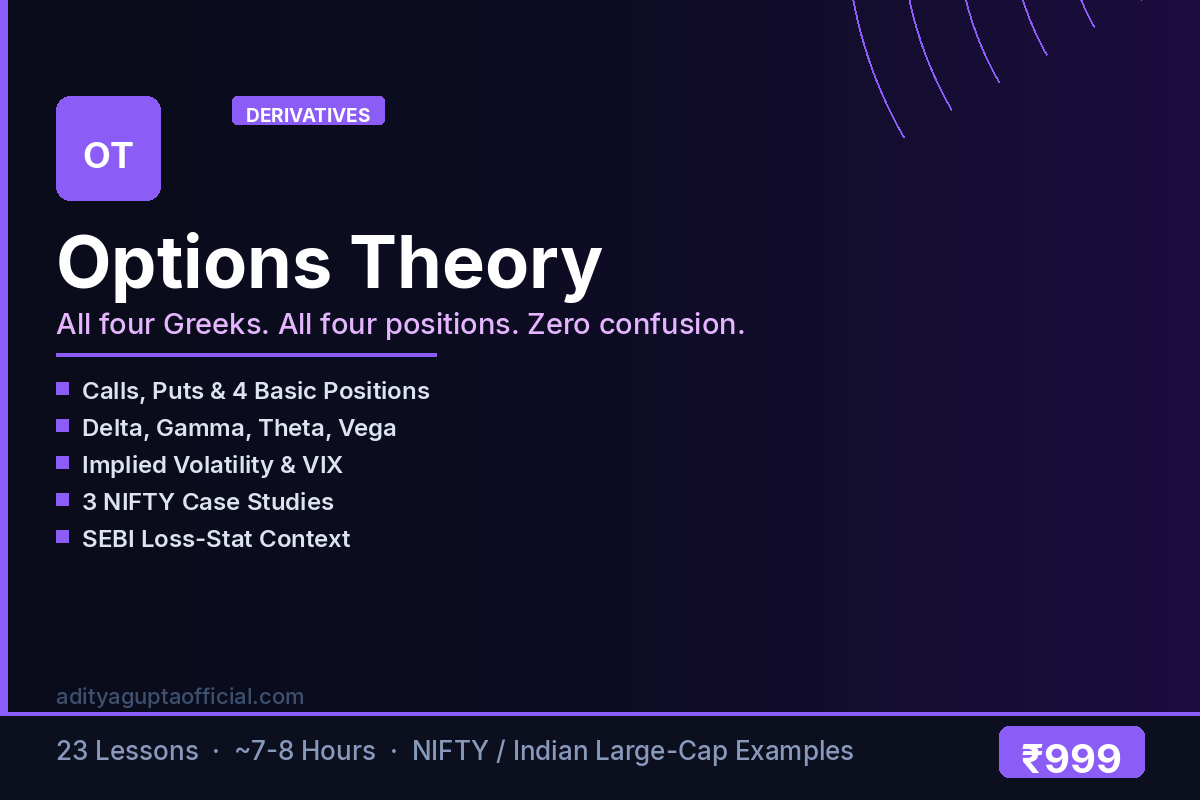
What you will learn
Options are powerful because they are flexible — and dangerous for exactly the same reason. This course builds your intuition for every moving part: how price, time, volatility, and probability come together to determine an option premium.
You will walk through Indian-market option-chain examples for Nifty, Bank Nifty, and large-cap stocks, master the four Greeks, and finish with a full understanding of how option prices respond to changes in spot, time, and implied volatility.
Topics covered (23 lessons)
- Call & Put options — from absolute basics
- Buying vs. writing options (long vs. short)
- Moneyness: ITM, ATM, OTM
- Delta (3 parts), Gamma (2 parts), Theta, Vega
- Volatility — historical, basics, normal distribution, applications
- Greek interactions and the Greek calculator
- Case studies pulling everything together
Who this is for
- Traders who feel they are guessing rather than analysing on the option chain
- Anyone preparing to take the Option Strategies course
- Quants and finance students learning derivatives pricing
What you will be able to do by the end
- Read an option chain and say what the premium is actually telling you (Lessons 1–8: call and put basics, jargon, moneyness)
- Explain the difference between buying and writing an option, and why the risk profiles are not mirror images (Lessons 3–7)
- Use Delta to judge how a position responds to a move in the underlying, and why it is not a fixed number (Lessons 9–11, three lessons on Delta alone)
- Anticipate how Gamma, Theta and Vega change a position as expiry approaches (Lessons 12–14, 19)
- Compute historical volatility and reason about it using the normal distribution (Lessons 15–18)
- See how the Greeks interact rather than treating them one at a time (Lesson 20, and the Greek calculator in Lesson 21)
- Work through complete case studies that combine pricing, volatility and the Greeks (Lessons 22–23)
Full curriculum — all 23 lessons
Every lesson in the course, in the order you will take them. This is the complete list — there is nothing held back.
- Call Option Basics
- Basic Option Jargons
- Buying a Call Option
- Writing (Selling) a Call Option
- Buying a Put Option
- Writing (Selling) a Put Option
- Summarising Call & Put Options
- Moneyness of an Option
- The Greeks — Delta (Part 1)
- Delta (Part 2)
- Delta (Part 3)
- Gamma (Part 1)
- Gamma (Part 2)
- Theta — Time Decay
- Volatility Basics
- Volatility Calculation (Historical)
- Volatility & Normal Distribution
- Volatility Applications
- Vega
- Greek Interactions
- The Greek Calculator
- Re-introducing Call & Put Options
- Case Studies — Pulling It Together
How the course is structured
The course runs in four stages, and the order matters — each stage assumes the one before it.
- Foundations (Lessons 1–8). Calls and puts, the jargon, what happens when you buy versus write, and moneyness. Nothing here requires prior options knowledge.
- The Greeks (Lessons 9–14, 19). Delta across three lessons, Gamma across two, then Theta and Vega. This is the largest block in the course because it is where most self-taught traders have gaps.
- Volatility (Lessons 15–18). Basics, historical calculation, the normal distribution, then applications. Volatility gets four lessons because it is the input people most often mis-handle.
- Putting it together (Lessons 20–23). Greek interactions, the Greek calculator, a re-introduction to calls and puts now that you have the machinery, and case studies.
Lesson 22 is deliberate: the course returns to calls and puts at the end, so you re-read the basics with the Greeks already in hand. Most people find that the point where it clicks.
What you need before you start
You need to know what a share is and how a stock exchange works. Beyond that, the course starts from the absolute basics of options — Lesson 1 is Call Option Basics.
On the maths: basic algebra is enough. The volatility lessons build normal-distribution intuition from scratch and no calculus is used anywhere in the course.
Futures are not a prerequisite, though many people take the Futures Trading course first because margin and leverage carry over.
What is included
- 23 written lessons — roughly 44000 words in total, with a typical lesson running around 1,940 words
- Worked Indian-market examples throughout, in rupees and against Indian instruments and regulations
- Self-paced access — start when you like, revisit any lesson, no schedule to keep up with
- Option-chain examples from Indian markets — Nifty, Bank Nifty and large-cap stocks, so the Greeks apply to instruments you actually trade
Where this sits among the courses
This is the theory layer of the derivatives track.
- Before, optionally: Futures Trading — margin, leverage and mark-to-market carry directly into options.
- This course: how an option is priced and what moves it.
- After: Option Strategies — multi-leg positions such as spreads, straddles and strangles. That course assumes the Greeks knowledge built here.
If you want to size positions and manage drawdown around these trades, Risk Management & Trading Psychology covers position sizing, Value at Risk and Kelly’s Criterion.
Frequently Asked Questions
Do I need maths background?
Basic algebra is enough. Volatility lessons include normal-distribution intuition, but no calculus is required.
Will this teach me option strategies?
No — this is the theory layer. For multi-leg strategies (straddles, spreads, ladders), take the Option Strategies course.
Is it useful for Bank Nifty / Nifty index options?
Yes. Every example uses Indian index and stock options so the Greeks and pricing intuition apply directly.
Does it cover weekly options?
Yes — the time-decay (Theta) lesson explicitly addresses how weeklies behave differently from monthlies.
How long are the lessons?
Each lesson is a long-form article — typically 15–25 minutes of reading. Self-paced and accessible forever after purchase.
Do I need to have traded options before?
No. The course opens at Lesson 1 with Call Option Basics and assumes no prior options experience. What it does assume is that you understand shares and how an exchange works.
Why do the Greeks take up so much of the course?
Because that is where most self-taught options traders have gaps. Delta alone runs across three lessons and Gamma across two — seven of the 23 lessons are Greeks, plus a further four on volatility. A trader who knows the payoff diagrams but not the Greeks is guessing at the part that actually determines the premium.
Is this enough on its own to start trading options?
It gives you the pricing and risk intuition. It does not cover multi-leg strategies — that is the Option Strategies course — and it does not cover position sizing or portfolio risk, which are in Risk Management & Trading Psychology. Treat this as the layer everything else is built on.
Already purchased? Go to course content →


Reviews
There are no reviews yet.