
What you will learn
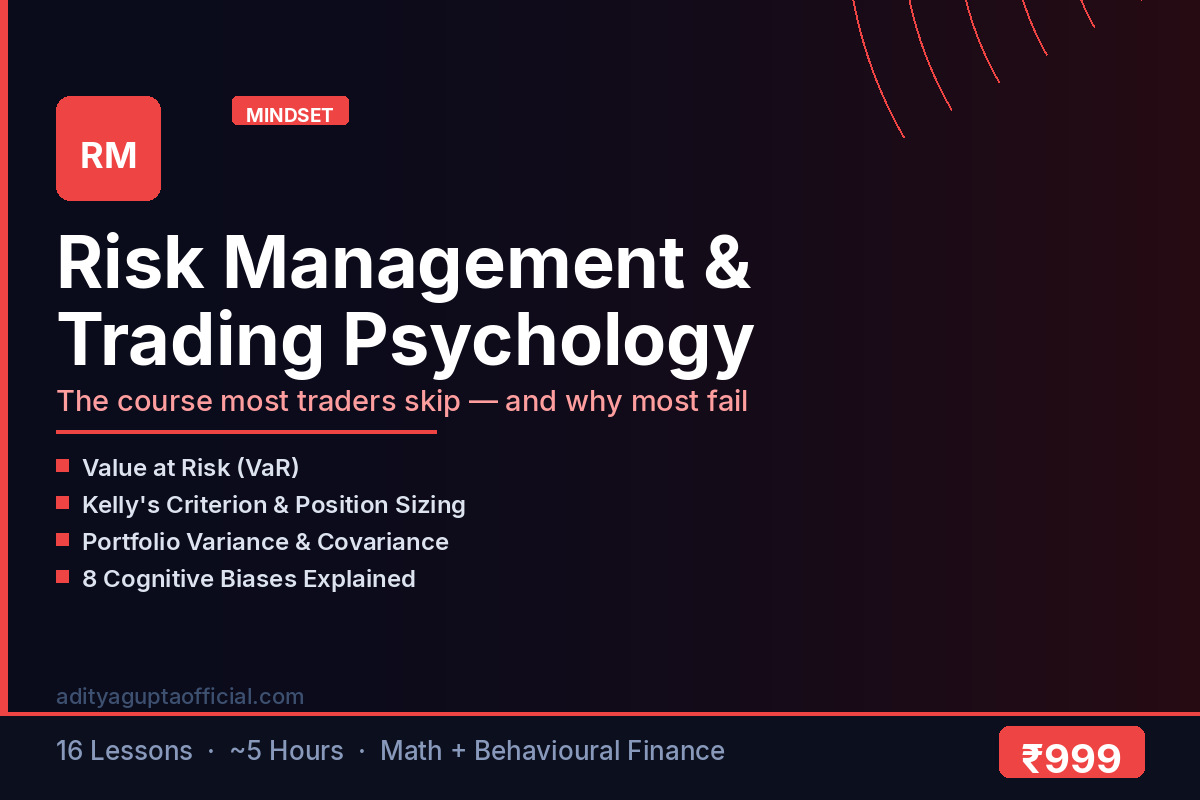
Strategies do not blow up accounts — poor risk management and untrained psychology do. This course pairs the quantitative discipline of position sizing and portfolio variance with the behavioural understanding of why traders self-sabotage.
You will leave with a written risk framework: how much to risk per trade, how to size a portfolio across correlated positions, what your equity curve is telling you, and which biases you are most prone to.
Topics covered (16 lessons)
- What risk really means — forms and definitions
- Variance, covariance, correlation matrices
- Portfolio variance and the variance-covariance matrix
- The equity curve — what to monitor
- Expected returns and probability thinking
- Portfolio optimisation (Parts 1 & 2)
- Value at Risk (VaR)
- Position sizing (3 parts)
- Kelly’s Criterion
- 16 trading biases (Parts 1 & 2)
Who this is for
- Anyone trading or investing with real money
- Traders who can pick setups but cannot grow capital
- Portfolio managers and prop traders building a risk process
What you will be able to do by the end
- Name and separate the different forms of risk in a portfolio (Lessons 1–2)
- Compute variance, covariance and a correlation matrix, and derive portfolio variance (Lessons 3–5)
- Read an equity curve for what it says about a strategy (Lesson 6)
- Estimate expected returns and optimise a portfolio across two lessons (Lessons 7–9)
- Calculate Value at Risk and understand what it does not capture (Lesson 10)
- Size positions properly — three lessons, plus Kelly’s Criterion (Lessons 11–14)
- Recognise the trading biases that undo sound analysis (Lessons 15–16)
Full curriculum — all 16 lessons
Every lesson in the course, in the order you will take them. This is the complete list — there is nothing held back.
- Orientation — What Risk Really Means
- Risk — The Many Forms
- Variance & Covariance
- Variance-Covariance Matrix
- Correlation Matrix & Portfolio Variance
- The Equity Curve
- Expected Returns
- Portfolio Optimization — Part 1
- Portfolio Optimization — Part 2
- Value at Risk (VaR)
- Position Sizing — Part 1
- Position Sizing — Part 2
- Position Sizing — Part 3
- Kelly’s Criterion
- Trading Biases — Part 1
- Trading Biases — Part 2
How the course is structured
Sixteen lessons in three parts: measuring risk, sizing against it, then the psychology that overrides both.
- Measuring (Lessons 1–10). What risk means, its forms, variance and covariance, the variance-covariance matrix, correlation and portfolio variance, the equity curve, expected returns, portfolio optimisation across two lessons, and Value at Risk.
- Sizing (Lessons 11–14). Position sizing across three lessons, then Kelly’s Criterion.
- Psychology (Lessons 15–16). Trading biases, two lessons.
Position sizing gets three lessons because it is the single decision that most determines whether a strategy survives a losing run.
What you need before you start
Comfort with basic statistics helps but is not assumed — variance and covariance are built up from Lesson 3 rather than taken as known.
The course is most useful once you already have positions to manage, whether from equities, futures or options.
What is included
- 16 written lessons — roughly 30000 words in total, with a typical lesson running around 1,902 words
- Worked Indian-market examples throughout, in rupees and against Indian instruments and regulations
- Self-paced access — start when you like, revisit any lesson, no schedule to keep up with
Where this sits among the courses
This course sits underneath everything else on the site.
- Pairs with: Option Strategies and Futures Trading — leveraged positions are where sizing errors become expensive.
- Also relevant to: Mutual Funds & ETFs, where correlation and asset allocation do the same work at portfolio level.
Frequently Asked Questions
Is the maths heavy?
There is matrix algebra in the variance-covariance lessons, but every formula is worked through with numbers. Excel is enough to follow along.
Will this fix my discipline issues?
It will name them. The last two lessons (Trading Biases Parts 1 & 2) cover 16 specific biases. Awareness is the first step — the rules and equity-curve monitoring give you guardrails.
Is Kelly Criterion safe to use?
Full Kelly is aggressive. The course covers fractional Kelly (half/quarter) which is what serious traders actually use.
Do I need a portfolio management background?
No. Concepts are introduced from scratch — by Lesson 10 you will be computing VaR yourself.
Is this only for traders?
No — long-term investors also benefit. Portfolio variance and correlation thinking apply equally to a buy-and-hold equity portfolio.
Is this only for traders?
No. Variance, covariance, correlation and portfolio optimisation apply to any portfolio. The position-sizing and bias lessons are most directly useful to active traders.
How much maths is involved?
More than the other courses, but built from scratch. Variance and covariance start at Lesson 3 and the matrix work follows from there. No prior statistics course is assumed.
What is Kelly’s Criterion doing in a trading course?
It is a formal answer to how much to stake given an edge and its odds. Lesson 14 covers both the formula and why full-Kelly sizing is usually too aggressive in practice.
Already purchased? Go to course content →


Reviews
There are no reviews yet.