
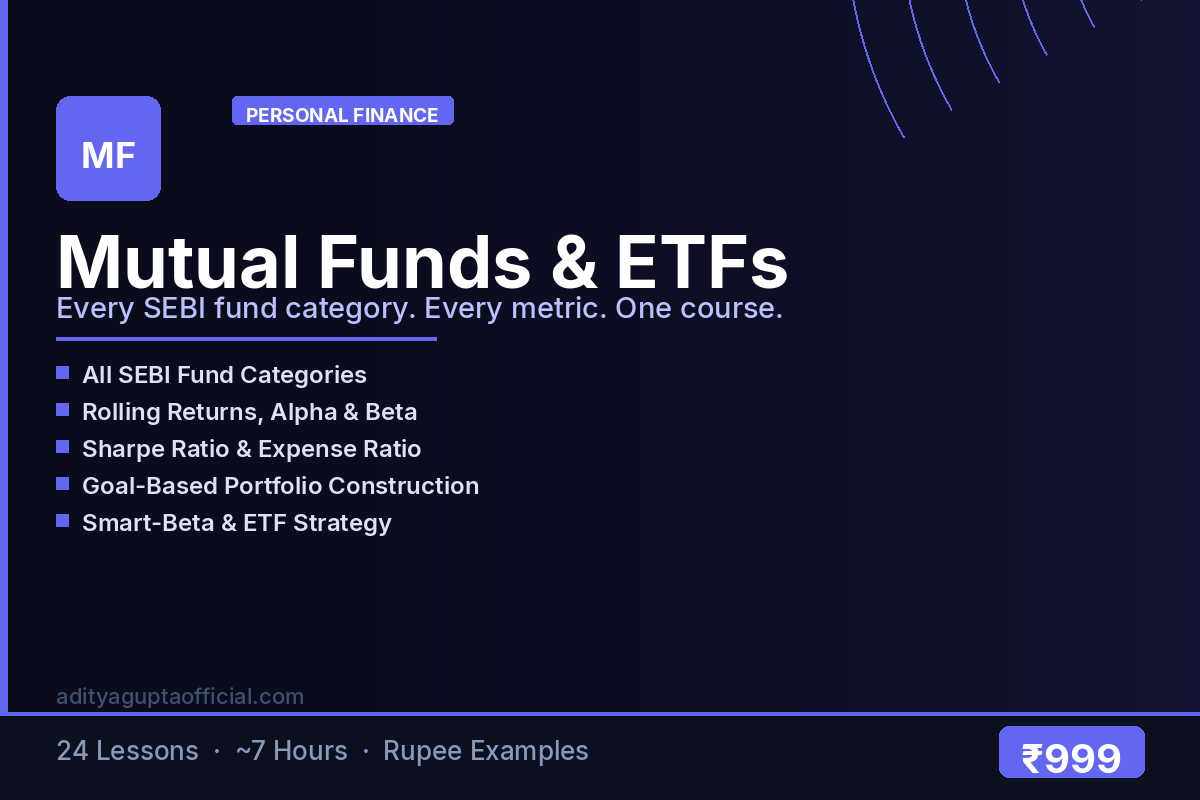
What you will learn
Mutual funds are how most Indians actually invest, but very few investors know how to compare funds rigorously. This course teaches the professional analyst’s toolkit — ratios, benchmarking, and portfolio construction — applied entirely to the Indian fund landscape.
By the end, you will be able to walk into any fund’s fact sheet, decode every metric, and decide if it deserves a place in your portfolio.
Topics covered (24 lessons)
- Introduction to mutual funds in India
- NAV, fact sheets, equity funds (Parts 1 & 2)
- Debt mutual funds (Parts 1–4) and bond direct investing
- Index funds, arbitrage funds, smart-beta funds
- Measuring returns: absolute, CAGR, XIRR, rolling returns
- Expense ratio, Direct vs Regular plans
- Benchmarking; Beta, Standard Deviation, Sharpe Ratio
- Sortino & Capture ratios
- How to analyse an equity / debt mutual fund
- Building a mutual fund portfolio
- Asset allocation
- Exchange-Traded Funds (ETFs) in India
What you will be able to do by the end
- Read a mutual fund fact sheet and understand what NAV actually represents (Lessons 2–3)
- Tell equity fund categories apart, and debt fund categories across four lessons (Lessons 4–9)
- Judge when a direct bond, an index fund or an arbitrage fund is the better instrument (Lessons 10–12)
- Measure returns properly, including rolling returns rather than point-to-point (Lessons 13–14)
- See what expense ratio and the direct-versus-regular choice cost you over time (Lesson 15)
- Benchmark a fund and read Beta, standard deviation, Sharpe, Sortino and capture ratios (Lessons 16–18)
- Run a full analysis of an equity fund and of a debt fund (Lessons 19–20)
- Build a portfolio, and place smart-beta funds and ETFs within it (Lessons 21–24)
Full curriculum — all 24 lessons
Every lesson in the course, in the order you will take them. This is the complete list — there is nothing held back.
- Introduction to Mutual Funds
- The Concept of NAV
- The Mutual Fund Fact Sheet
- Equity Mutual Funds — Part 1
- Equity Mutual Funds — Part 2
- Debt Mutual Funds — Part 1
- Debt Mutual Funds — Part 2
- Debt Mutual Funds — Part 3
- Debt Mutual Funds — Part 4
- Investing in Bonds Directly
- Index Funds
- Arbitrage Funds
- Measuring Mutual Fund Returns
- Rolling Returns
- Expense Ratio + Direct vs Regular Plans
- Mutual Fund Benchmarking
- Beta, Standard Deviation & Sharpe Ratio
- Sortino & Capture Ratios
- How to Analyse an Equity Mutual Fund
- How to Analyse a Debt Mutual Fund
- Building a Mutual Fund Portfolio
- Smart-Beta Funds
- Asset Allocation
- Exchange-Traded Funds (ETFs)
How the course is structured
Twenty-four lessons — the longest course on the site — in five parts.
- Foundations (Lessons 1–3). What a mutual fund is, NAV, and the fact sheet.
- Categories (Lessons 4–12). Equity funds across two lessons, debt funds across four, then direct bonds, index funds and arbitrage funds.
- Measurement (Lessons 13–18). Returns, rolling returns, expense ratio and direct-versus-regular, benchmarking, and the risk-adjusted ratios.
- Analysis (Lessons 19–20). A worked analysis of an equity fund and of a debt fund.
- Portfolio (Lessons 21–24). Construction, smart-beta, asset allocation, ETFs.
Debt funds get four lessons against equity’s two. That is deliberate — debt funds are where most Indian investors misjudge the risk they are taking.
What you need before you start
None. The course opens at what a mutual fund is and builds from there.
If you want a sense of the territory first, active versus index funds and debt funds versus fixed deposits are free comparisons on closely related ground.
What is included
- 24 written lessons — roughly 43000 words in total, with a typical lesson running around 1,809 words
- Worked Indian-market examples throughout, in rupees and against Indian instruments and regulations
- Self-paced access — start when you like, revisit any lesson, no schedule to keep up with
Where this sits among the courses
This is the investing-products track and it stands alone.
- Complementary: Fundamental Analysis for judging individual companies rather than funds.
- Portfolio-level: Risk Management & Trading Psychology covers correlation and optimisation in more depth than Lesson 23 does.
Frequently Asked Questions
Is this just theory or is it actionable?
Actionable — every metric lesson uses real Indian fund examples (HDFC, ICICI, SBI, Mirae, Parag Parikh, etc.) so you can apply it the same day.
Does it cover SIP vs lumpsum?
Yes, indirectly. The lessons on rolling returns, CAGR, and the equity-fund framework cover when each makes sense.
Are ETFs covered?
Yes — Lesson 24 covers ETFs in detail, including how they differ from index funds and when each is more efficient in the Indian context.
Will I learn how to pick a fund?
Yes — Lessons 19 & 20 are step-by-step ‘How to analyse an equity / debt mutual fund’ lessons with checklists.
Is asset allocation included?
Yes — Lesson 23 is dedicated to asset allocation, including age-based and goal-based frameworks suited to Indian investors.
Is this useful if I only invest through SIPs?
Yes, and arguably most useful there. The measurement lessons — rolling returns, expense ratio, benchmarking, Sharpe and Sortino — are exactly how you tell whether the fund your SIP runs into is worth holding.
Why do debt funds get four lessons?
Because debt funds carry credit and duration risk that most investors do not price, and because the category labels are not self-explanatory. Four lessons is what it takes to make the distinctions usable.
Does it cover ETFs and index funds separately?
Yes. Index funds are Lesson 11, smart-beta funds Lesson 22, and ETFs close the course at Lesson 24 — including how they differ from an index fund in practice.
Already purchased? Go to course content →


Reviews
There are no reviews yet.