
What you will learn
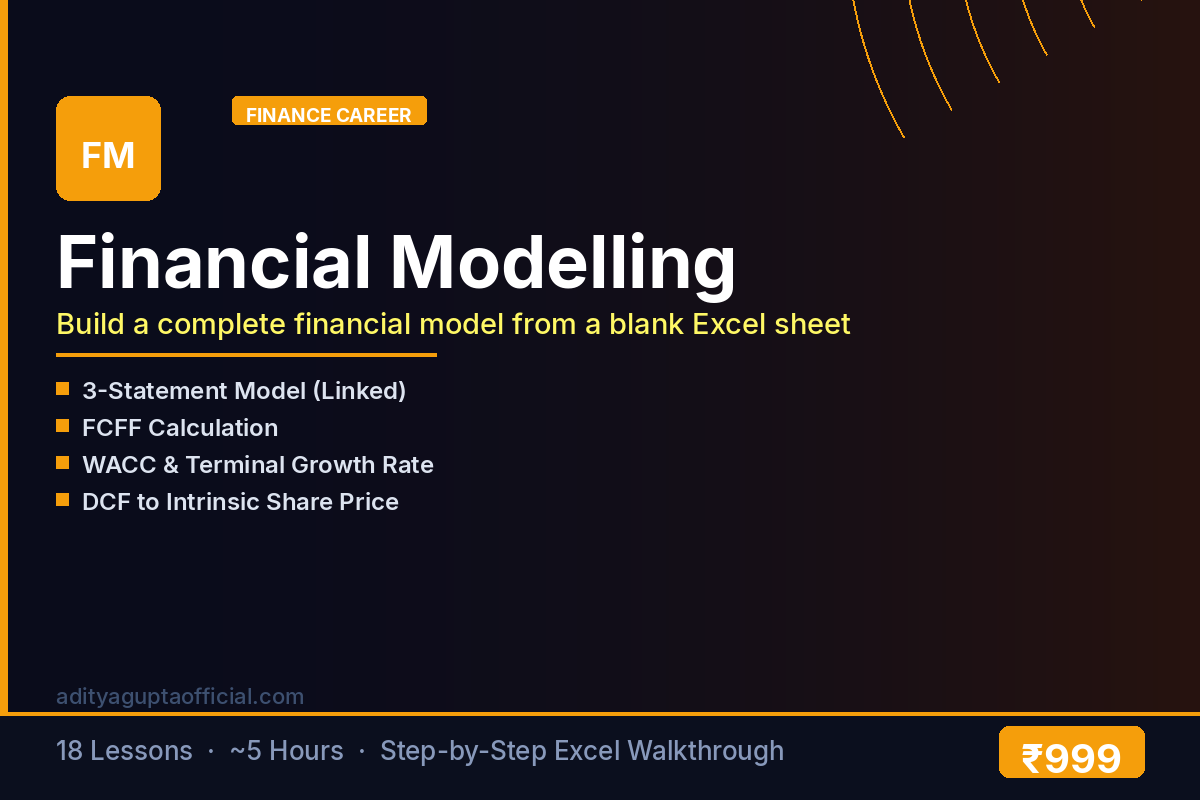
This is the practitioner course every aspiring equity analyst, investment banker, and CA-finance professional should run through at least once. You will build a complete three-statement model in Excel — historicals, assumptions, revenue model, schedules, projections, and a DCF valuation — step by step.
The teaching company throughout is an Indian listed business so units, accounting framework, and disclosures are familiar.
Topics covered (18 lessons)
- Introduction to financial modelling
- Excel workbook setup and best practices
- Pulling and cleaning historical data
- Assumptions (Parts 1 & 2)
- Revenue model
- Asset schedule (Parts 1 & 2)
- Debt schedule
- Reserves schedule (Parts 1 & 2)
- Projections
- Cash flow statement build
- Valuation (3 parts): overview, FCFF & FCFE, risk premium & tax shield
- WACC and terminal growth
- Full DCF analysis
Who this is for
- Investment banking and equity research aspirants
- MBA, CFA Level 2 candidates
- Investors who want a quantitative valuation toolkit
What you will be able to do by the end
- Set up a modelling workbook that stays auditable as it grows (Lesson 2)
- Structure historical data and drive a model from explicit assumptions (Lessons 3–5)
- Build a revenue model, asset schedule, debt schedule and reserves schedule (Lessons 6–11)
- Produce projections and a derived cash flow statement (Lessons 12–13)
- Work through FCFF and FCFE and know when each applies (Lessons 14–15)
- Handle the risk premium and tax shield correctly (Lesson 16)
- Compute WACC and a defensible terminal growth rate (Lesson 17)
- Complete a discounted cash flow valuation end to end (Lesson 18)
Full curriculum — all 18 lessons
Every lesson in the course, in the order you will take them. This is the complete list — there is nothing held back.
- Introduction to Financial Modelling
- Excel Workbook Setup
- Historical Data
- Assumptions (Part 1)
- Assumptions (Part 2)
- Revenue Model
- Asset Schedule (Part 1)
- Asset Schedule (Part 2)
- Debt Schedule
- Reserves Schedule (Part 1)
- Reserves Schedule (Part 2)
- Projections
- Cash Flow Statement
- Valuation (Part 1) — Overview
- Valuation (Part 2) — FCFF & FCFE
- Valuation (Part 3) — Risk Premium & Tax Shield
- WACC and Terminal Growth
- Discounted Cash Flow Analysis (DCF)
How the course is structured
Eighteen lessons that build one model, in the order you would build it.
- Setup (Lessons 1–5). Workbook structure, historical data, and assumptions across two lessons.
- Schedules (Lessons 6–11). Revenue, asset schedule across two lessons, debt schedule, reserves across two.
- Outputs (Lessons 12–13). Projections and the cash flow statement that falls out of them.
- Valuation (Lessons 14–18). Overview, FCFF and FCFE, risk premium and tax shield, WACC and terminal growth, then the DCF itself.
The schedules take six lessons because a DCF is only as good as the schedules feeding it.
What you need before you start
You need to be able to read an income statement, balance sheet and cash flow statement. Fundamental Analysis covers exactly that ground and is the natural course to take first.
Working spreadsheet ability is assumed — formulas and cell references, not macros.
What is included
- 18 written lessons — roughly 32000 words in total, with a typical lesson running around 1,767 words
- Worked Indian-market examples throughout, in rupees and against Indian instruments and regulations
- Self-paced access — start when you like, revisit any lesson, no schedule to keep up with
Where this sits among the courses
This is the valuation track.
- Before: Fundamental Analysis — its Lesson 14 DCF primer is the short version of what this course builds properly.
Free tools on related ground: the NPV calculator and the IRR calculator.
Frequently Asked Questions
Do I need Excel skills?
Intermediate Excel is enough — if you know cell references, INDEX/MATCH, and IF, you will manage. Macros are not used.
Will I get an Excel template?
The course teaches you to build the model from scratch, which is the real skill. You will end up with your own complete template.
Is DCF really covered end-to-end?
Yes — Lessons 16–18 walk through FCFF, FCFE, risk premium, tax shield, WACC, terminal growth, and a full DCF on a sample Indian company.
Does it teach LBO or M&A models?
No — it is focused on the three-statement model and DCF valuation. LBO and M&A would be follow-on courses.
Is this prep for an analyst job?
Yes — the model build, valuation rigour, and equity-research thinking match what’s expected on the desk.
Do I need Fundamental Analysis first?
Strongly recommended. This course builds a model from the three statements and does not teach how to read them. If the balance sheet is unfamiliar, start there.
What spreadsheet skill is assumed?
Formulas, references and basic structure. Lesson 2 covers workbook setup for modelling specifically. Macros and VBA are not used.
Does it end with a complete valuation?
Yes. Lesson 18 is a full discounted cash flow analysis, built on the WACC and terminal growth work in Lesson 17 and the FCFF/FCFE lessons before it.
Already purchased? Go to course content →


Reviews
There are no reviews yet.