
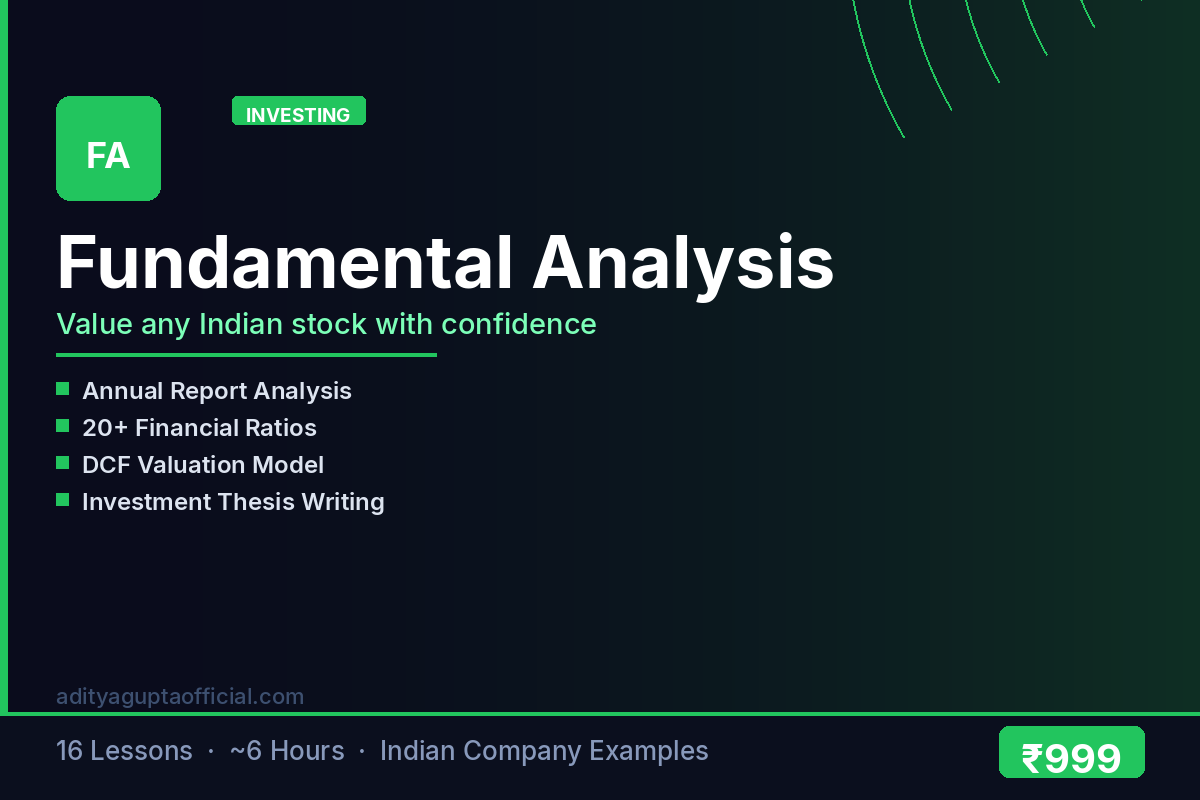
What you will learn
This course transforms how you look at a stock. Instead of reacting to tips or news, you learn the patient craft of reading annual reports, decoding the three financial statements, and forming a quantitative view on whether a company is worth owning at today’s price.
Every chapter uses Rupee-denominated examples and ratios drawn from real Indian listed companies — so the context, accounting nuance, and red flags are exactly what a domestic equity investor will encounter.
Topics covered (16 lessons)
- The mindset of an investor
- How to read an annual report cover-to-cover
- Income Statement (P&L) — Parts 1 & 2
- Balance Sheet — Parts 1 & 2
- Cash Flow Statement
- Financial Ratio Analysis — profitability, liquidity, efficiency, leverage, valuation
- Investment due diligence framework
- Equity research note structure (Parts 1 & 2)
- DCF (Discounted Cash Flow) primer
- Building a full investment thesis
Who this is for
- Investors who want to pick stocks based on numbers, not noise
- Aspiring equity research analysts, MBAs, CFA candidates
- Anyone preparing to invest seriously in Indian large-cap or mid-cap stocks
What you will be able to do by the end
- Work through an annual report and know which sections actually matter (Lesson 3)
- Read an income statement and a balance sheet line by line (Lessons 4–7)
- Read a cash flow statement and see where reported profit and cash diverge (Lesson 8)
- Compute and interpret the ratios that matter, across three lessons rather than a cheat sheet (Lessons 9–11)
- Run a due-diligence checklist over a company before committing money (Lesson 12)
- Produce an equity research note of your own (Lessons 13, 15)
- Build a discounted cash flow valuation from first principles (Lesson 14)
Full curriculum — all 16 lessons
Every lesson in the course, in the order you will take them. This is the complete list — there is nothing held back.
- Introduction to Fundamental Analysis
- The Mindset of an Investor
- How to Read an Annual Report
- The Income Statement — Part 1
- The Income Statement — Part 2
- The Balance Sheet — Part 1
- The Balance Sheet — Part 2
- The Cash Flow Statement
- Financial Ratio Analysis — Part 1
- Financial Ratio Analysis — Part 2
- Financial Ratio Analysis — Part 3
- Investment Due Diligence
- Equity Research — Part 1
- DCF Primer
- Equity Research — Part 2
- The Finale
How the course is structured
Sixteen lessons that follow the order you would actually analyse a company in.
- Mindset (Lessons 1–2). What fundamental analysis is for, and the investor temperament it requires.
- The statements (Lessons 3–8). The annual report, then the income statement, balance sheet and cash flow statement — two lessons each on the first two.
- Ratios (Lessons 9–11). Three lessons, because ratios are only useful in relation to each other.
- Applying it (Lessons 12–16). Due diligence, equity research, a DCF primer, and a finale that ties the process together.
What you need before you start
No accounting background is required. The statements are taught from scratch, starting with how to navigate an annual report.
If you would like a free head start on the statements themselves, the guide to reading an Indian balance sheet covers similar ground at an introductory level.
What is included
- 16 written lessons — roughly 36000 words in total, with a typical lesson running around 2,169 words
- Worked Indian-market examples throughout, in rupees and against Indian instruments and regulations
- Self-paced access — start when you like, revisit any lesson, no schedule to keep up with
Where this sits among the courses
This is the investing track.
- Complementary: Technical Analysis — this course is what to buy, that one is when.
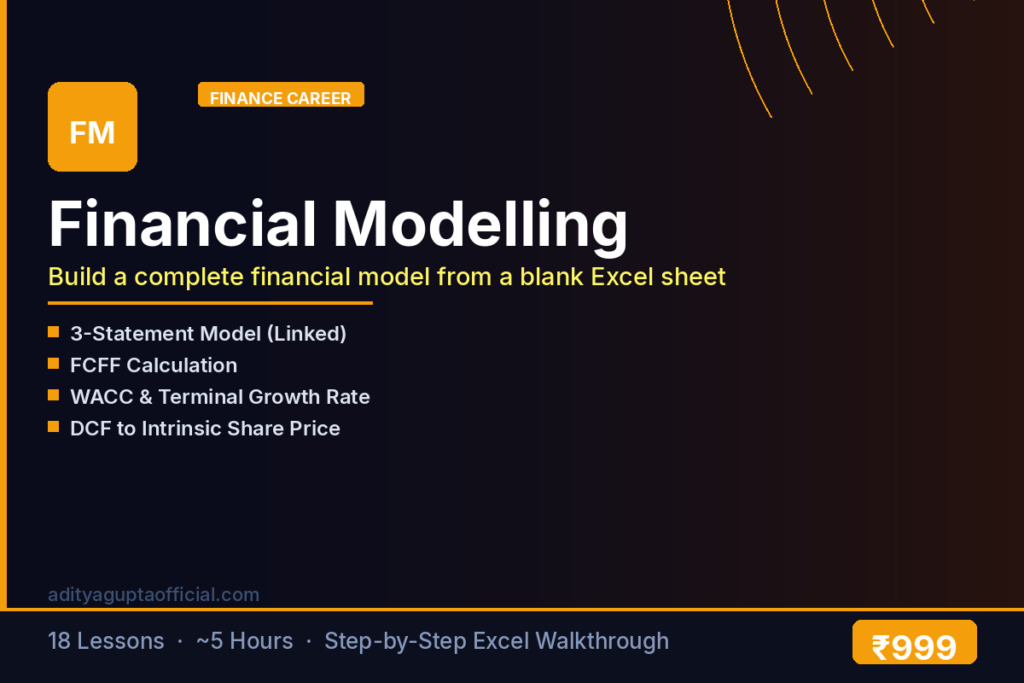
- Next, for valuation depth: Financial Modelling builds the full three-statement model and DCF that Lesson 14 introduces.
Frequently Asked Questions
Do I need an accounting background?
No. Lessons 4–8 teach you exactly the accounting needed to read Indian Ind-AS statements — no CA or commerce degree assumed.
Will I be able to research any Indian stock after this?
Yes. The framework is universal across sectors. You will know how to pull data from BSE/NSE filings, screener.in, or money control and form your own thesis.
Does it cover DCF valuation?
Yes — Lesson 14 is a DCF primer with a worked example you can replicate in Excel.
Is it Technical Analysis too?
No. This is purely fundamental. For chart-reading, take the Technical Analysis course separately — the two are complementary.
How is it different from a CFA Level 1 prep course?
CFA covers theory across asset classes; this course is hands-on equity research focused on Indian companies — narrower, more practical, no exam pressure.
Do I need an accounting background?
No. The course teaches the income statement, balance sheet and cash flow statement from the ground up, with two lessons each on the first two.
How is this different from the Financial Modelling course?
This course teaches you to read and judge a company’s financials and produce a research view. Financial Modelling teaches you to build the projection and valuation model in a spreadsheet. Lesson 14 here is a DCF primer; that course is the full build.
Does it use Indian companies?
Yes — annual reports, statements and disclosure conventions are taught as they appear for Indian listed companies.
Already purchased? Go to course content →


Reviews
There are no reviews yet.