
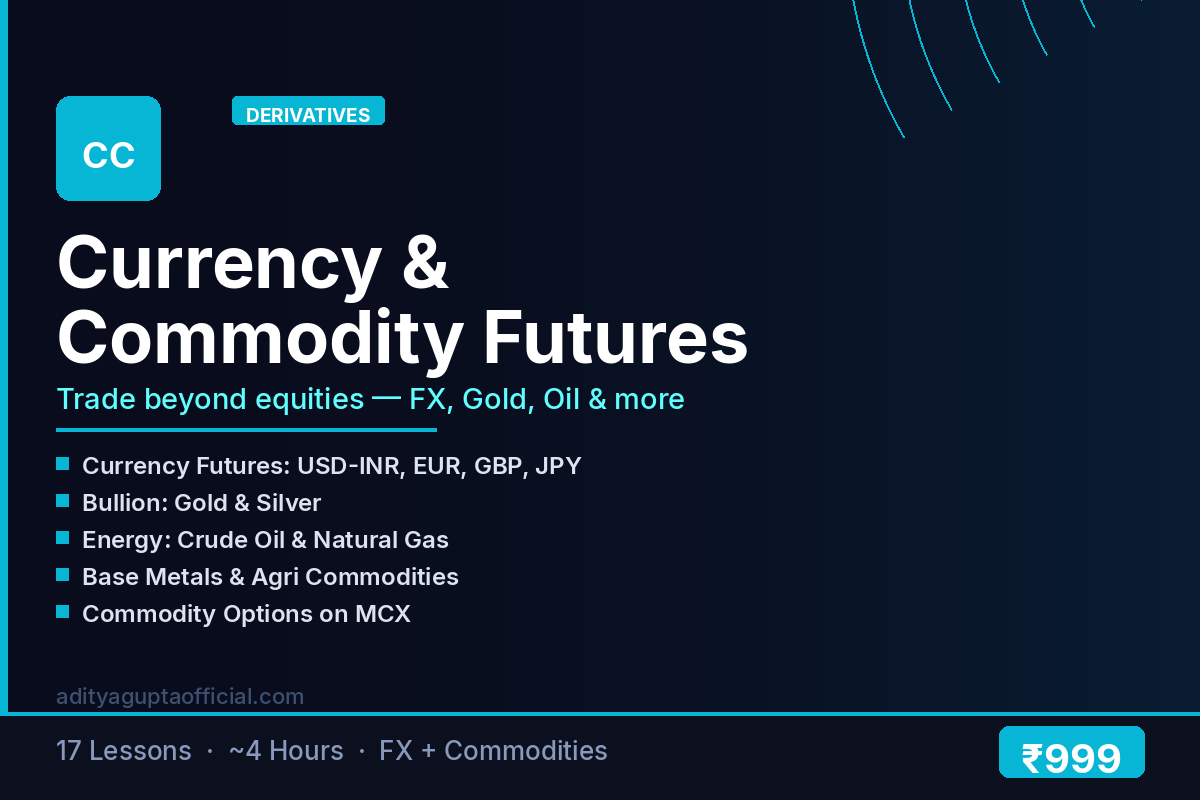
What you will learn
India’s currency and commodity derivative markets are deep, liquid, and unfairly ignored by retail traders. This course teaches you the macro context, contract specifications, and trade structures specific to MCX commodities and NSE/BSE currency futures.
Every lesson covers a specific instrument or concept — from why USD-INR moves on RBI policy to how the global crude ecosystem feeds the MCX crude oil contract.
Topics covered (17 lessons)
- Currency basics and reference rates
- Brexit & Interest Rate Parity (IRP)
- The USD-INR pair (Parts 1 & 2)
- EUR, GBP, and JPY pairs
- Gold (Parts 1 & 2) and silver
- Crude oil ecosystem and the MCX crude contract (3 parts)
- Copper, aluminium, lead, nickel
- Cardamom & mentha oil (agri commodities)
- Natural gas
- Commodity options
Who this is for
- Traders looking beyond equity F&O for diversification
- Hedgers — jewellers, exporters, importers, energy buyers
- Macro-oriented investors interested in commodity cycles
What you will be able to do by the end
- Understand how currency pairs are quoted and what moves a reference rate (Lessons 1–2)
- Apply interest rate parity, using Brexit as the worked case (Lesson 3)
- Trade the USD-INR pair with the mechanics covered across two lessons (Lessons 4–5)
- Extend the same reasoning to EUR, GBP and JPY (Lesson 6)
- Analyse gold and silver as traded contracts rather than as sentiment (Lessons 7–9)
- Follow crude oil across its history, ecosystem and contract specification (Lessons 10–12)
- Handle base metals and the agri contracts on Indian exchanges (Lessons 13–15)
- Trade natural gas and commodity options (Lessons 16–17)
Full curriculum — all 17 lessons
Every lesson in the course, in the order you will take them. This is the complete list — there is nothing held back.
- Currency Basics
- Reference Rates & Impact of Events
- Brexit & Interest Rate Parity
- The USD-INR Pair (Part 1)
- The USD-INR Pair (Part 2)
- EUR, GBP, and JPY
- Gold (Part 1)
- Gold (Part 2)
- Silver
- Crude Oil (Part 1) — Digging the Past
- Crude Oil (Part 2) — The Crude Oil Ecosystem
- Crude Oil (Part 3) — The Crude Oil Contract
- Copper & Aluminium
- Lead & Nickel
- Cardamom & Mentha Oil
- Natural Gas
- Commodity Options
How the course is structured
Seventeen lessons, split between currencies and commodities.
- Currencies (Lessons 1–6). Basics, reference rates and events, interest rate parity via Brexit, the USD-INR pair across two lessons, then EUR, GBP and JPY.
- Precious metals (Lessons 7–9). Gold across two lessons, then silver.
- Energy (Lessons 10–12, 16). Crude oil across three lessons — history, ecosystem, contract — and natural gas.
- Metals and agri (Lessons 13–15). Copper and aluminium, lead and nickel, cardamom and mentha oil.
- Options (Lesson 17). Commodity options.
Crude oil gets three lessons because the contract is difficult to trade well without understanding the physical ecosystem behind it.
What you need before you start
Futures mechanics — margin, mark-to-market, leverage and contract specification — are assumed. Futures Trading covers them and is the natural prerequisite.
Lesson 17 touches commodity options; Options Theory helps there but is not required for the other sixteen lessons.
What is included
- 17 written lessons — roughly 29000 words in total, with a typical lesson running around 1,659 words
- Worked Indian-market examples throughout, in rupees and against Indian instruments and regulations
- Self-paced access — start when you like, revisit any lesson, no schedule to keep up with
Where this sits among the courses
This is the specialist end of the derivatives track.
- Before: Futures Trading.
- Helpful for Lesson 17: Options Theory.
On the investing side rather than the trading side, gold versus mutual funds is a free comparison covering how gold is taxed and held in India.
Frequently Asked Questions
Is MCX/NSE F&O account required?
Recommended for execution. You can follow along without one, but to trade you will need a SEBI-registered broker offering MCX (Zerodha, Angel One, Motilal Oswal, etc.).
Are agri commodities covered?
Yes — cardamom and mentha oil get a dedicated lesson, and the pricing concepts apply across other agri contracts.
Does it cover crypto futures?
No — the focus is regulated currency and commodity futures on Indian exchanges (NSE, BSE, MCX).
Will I learn hedging for a small business?
Yes — the ecosystem lessons (gold, crude, USD-INR) explicitly cover how an Indian importer or jeweller can hedge price risk.
How are commodity options different from futures?
Commodity options have non-linear payoffs and are typically European-style. Lesson 17 walks through the differences and when to prefer one over the other.
Do I need the Futures Trading course first?
In practice yes. This course applies futures mechanics to currency and commodity contracts rather than re-teaching margin, mark-to-market and leverage.
Which commodities are actually covered?
Gold across two lessons, silver, crude oil across three, copper and aluminium, lead and nickel, cardamom and mentha oil, and natural gas — then commodity options.
Is the currency section only about USD-INR?
No. USD-INR gets two lessons as the most traded pair, and Lesson 6 extends the same framework to EUR, GBP and JPY. Lessons 2 and 3 cover reference rates and interest rate parity, which apply to any pair.
Already purchased? Go to course content →

Reviews
There are no reviews yet.