
What you will learn
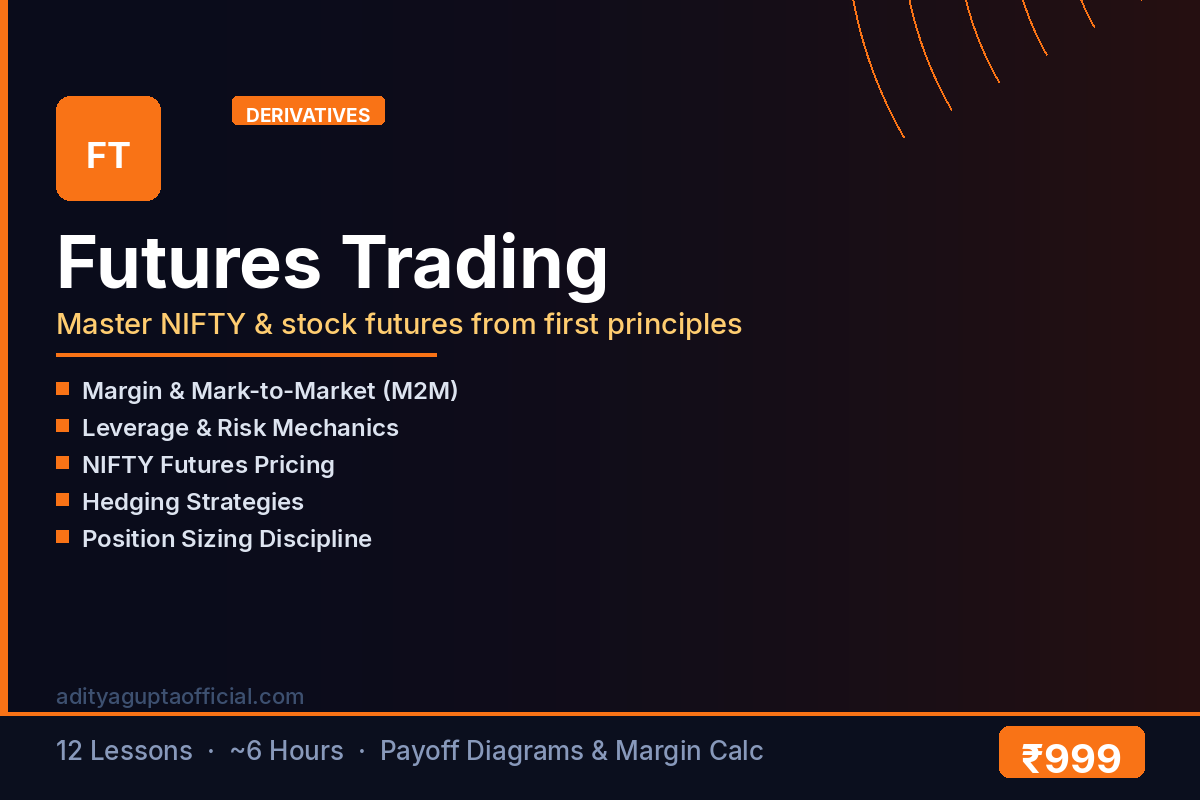
Futures contracts are the most liquid derivatives on Indian exchanges, but they are also the easiest place for a beginner to blow up an account. This course gives you the conceptual map and operational discipline to trade futures responsibly.
From the forwards-market origins to today’s NSE Nifty futures, you will understand exactly how a contract is priced, why mark-to-market matters, and how to use futures both for directional trades and for portfolio hedging.
Topics covered (12 lessons)
- The forwards market and why futures evolved
- Futures contract specifications
- Leverage, payoff, and margin mechanics
- Mark-to-Market and the margin calculator
- Shorting in the futures market
- The Nifty futures contract in detail
- Futures pricing and fair value
- Hedging with futures
- Open interest — reading the smart money
Who this is for
- Equity traders looking to extend into derivatives
- Long-only investors who want to hedge a portfolio
- Anyone planning to trade NSE F&O
What you will be able to do by the end
- Explain what a futures contract is and how it differs from the forward it evolved from (Lessons 1–2)
- Place and reason about a futures trade, including the leverage it gives you (Lessons 3–4)
- Work out margin requirements and follow a position through mark-to-market (Lessons 5–7)
- Short a market properly, and understand why futures make shorting straightforward (Lesson 8)
- Price a futures contract and read the basis against spot (Lessons 9–10)
- Hedge an existing holding with futures rather than selling it (Lesson 11)
- Interpret open interest alongside price and volume (Lesson 12)
Full curriculum — all 12 lessons
Every lesson in the course, in the order you will take them. This is the complete list — there is nothing held back.
- Background — The Forwards Market
- Introducing Futures Contracts
- The Futures Trade
- Leverage & Payoff
- Margin & Mark-to-Market
- The Margin Calculator — Part 1
- The Margin Calculator — Part 2
- All About Shorting
- The Nifty Futures
- Futures Pricing
- Hedging with Futures
- Open Interest
How the course is structured
Twelve lessons that move from the contract itself to what you can do with it.
- What a future is (Lessons 1–2). The forwards market and the problems futures were designed to solve.
- Mechanics (Lessons 3–8). The trade, leverage and payoff, margin and mark-to-market, two lessons on the margin calculator, and shorting.
- The Indian market (Lessons 9–10). Nifty futures specifically, then pricing.
- Applications (Lessons 11–12). Hedging, and open interest.
Half the course is mechanics, deliberately. Leverage and margin are where futures positions are actually lost.
What you need before you start
You need to understand shares and how an exchange works. No derivatives background is assumed — Lesson 1 starts with the forwards market.
Comfort with percentages and simple arithmetic is enough; there is no advanced maths in this course.
What is included
- 12 written lessons — roughly 26000 words in total, with a typical lesson running around 2,154 words
- Worked Indian-market examples throughout, in rupees and against Indian instruments and regulations
- Self-paced access — start when you like, revisit any lesson, no schedule to keep up with
Where this sits among the courses
This is usually the first course in the derivatives track.
- After: Options Theory — margin, leverage and mark-to-market carry straight over.
- Then: Option Strategies.
- Related: Currency & Commodity Futures applies the same mechanics to USD-INR, gold, crude and metals.
Frequently Asked Questions
Is futures trading risky?
Yes. Futures use leverage, so small adverse moves can wipe out the margin. This course builds the risk discipline you need before placing your first trade.
Do I need a broker account?
Yes — an F&O-enabled account with any SEBI-registered broker (Zerodha, Groww, Upstox, etc.). The course does not require one to follow along, only to apply it.
Does it cover commodity futures too?
Only equity-index and stock futures here. For MCX and currency futures, take the Currency & Commodity Futures course.
How is this different from Options Theory?
Futures have linear payoffs and no time decay; options have non-linear payoffs, Greeks, and volatility. Futures are simpler to model, options are richer.
Will I learn specific strategies?
Yes — hedging, calendar spreads, and the role of open interest are covered. For advanced multi-leg strategies, the Option Strategies course complements this one.
Do I need to know options first?
No — the reverse, if anything. Futures are the simpler instrument and most people find margin, leverage and mark-to-market easier to absorb here before meeting them again in an options context.
Is this specific to Indian markets?
Yes. Lesson 9 covers Nifty futures directly, and margin and settlement are taught as they work on Indian exchanges.
Does it cover hedging an existing portfolio?
Lesson 11 is devoted to hedging with futures — protecting a holding you do not want to sell, rather than taking a fresh directional position.
Already purchased? Go to course content →


Reviews
There are no reviews yet.