
What you will learn
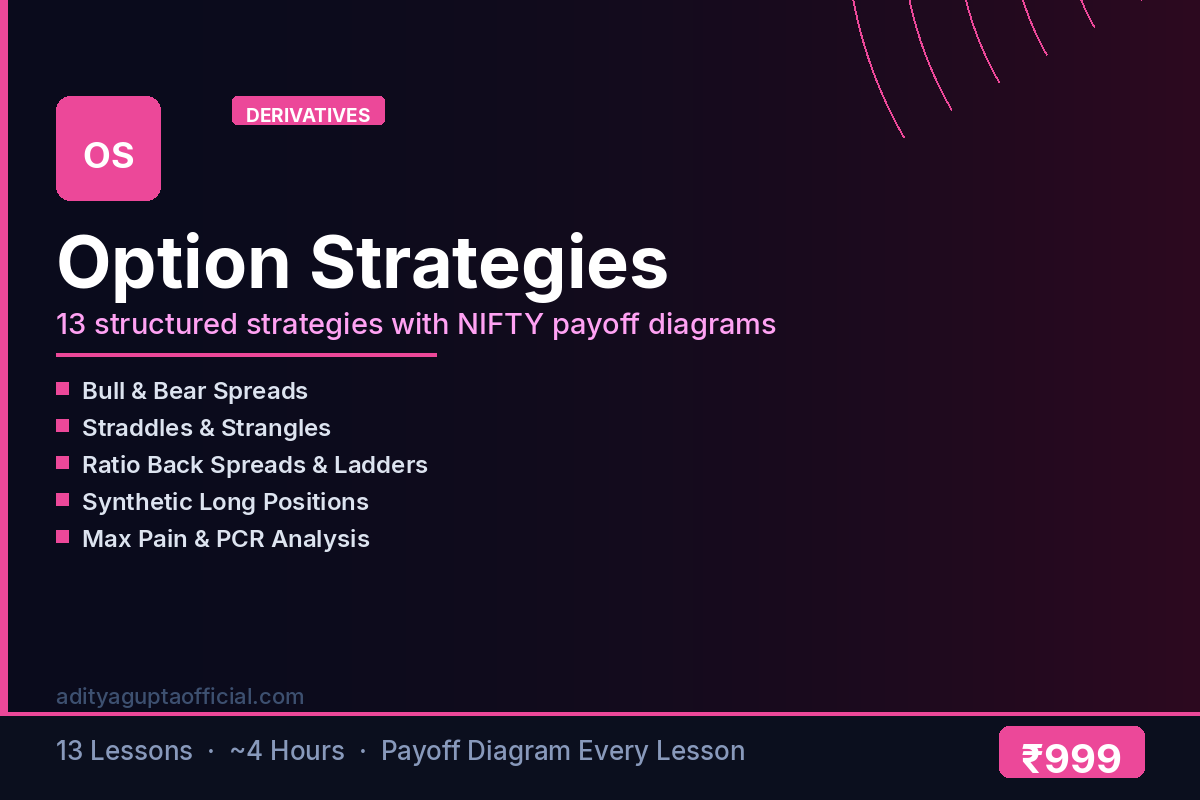
Once you understand options theory, the next step is combining contracts into strategies that express a specific view — bullish, bearish, range-bound, or volatility-based. This course teaches the construction, payoff, breakeven, and ideal market scenario for each strategy.
Each lesson includes a Nifty/Bank Nifty example with strike selection logic, max-profit/max-loss math, and exit triggers.
Strategies covered (13 lessons)
- Orientation — strategy fundamentals
- Bull Call Spread, Bull Put Spread
- Call Ratio Back Spread, Bear Call Ladder
- Synthetic Long & Arbitrage
- Bear Put Spread, Bear Call Spread, Put Ratio Back Spread
- Long Straddle, Short Straddle
- Long & Short Strangles
- Max Pain & Put-Call Ratio (PCR)
Prerequisite
You should be comfortable with Greeks and option-chain reading. If not, take the Options Theory course first.
What you will be able to do by the end
- Choose a spread that matches a specific directional view instead of buying a naked option (Lessons 2–3, 7–8)
- Build and manage bull and bear positions on both the call and put side (Lessons 2–3, 7–8)
- Use ratio back spreads and the bear call ladder where a simple spread is the wrong tool (Lessons 4–5, 9)
- Construct a synthetic long and recognise an arbitrage when the pricing allows it (Lesson 6)
- Trade volatility rather than direction using straddles and strangles, long and short (Lessons 10–12)
- Read Max Pain and the Put-Call Ratio for what they do and do not tell you (Lesson 13)
Full curriculum — all 13 lessons
Every lesson in the course, in the order you will take them. This is the complete list — there is nothing held back.
- Orientation — Strategy Fundamentals
- Bull Call Spread
- Bull Put Spread
- Call Ratio Back Spread
- Bear Call Ladder
- Synthetic Long & Arbitrage
- Bear Put Spread
- Bear Call Spread
- Put Ratio Back Spread
- The Long Straddle
- The Short Straddle
- Long & Short Strangles
- Max Pain & Put-Call Ratio
How the course is structured
Thirteen lessons, grouped by what you are actually expressing with the trade.
- Orientation (Lesson 1). What a strategy is for, and how to think about payoff, breakeven and margin before placing one.
- Bullish structures (Lessons 2–6). Bull call spread, bull put spread, call ratio back spread, bear call ladder, then synthetic long and arbitrage.
- Bearish structures (Lessons 7–9). Bear put spread, bear call spread, put ratio back spread.
- Volatility structures (Lessons 10–12). Long straddle, short straddle, then long and short strangles — positions with no directional view at all.
- Market-wide reads (Lesson 13). Max Pain and the Put-Call Ratio.
The bullish and bearish blocks mirror each other deliberately, so each structure is learned alongside its opposite rather than in isolation.
What you need before you start
This course assumes options theory. It works with Delta, Theta and implied volatility from Lesson 1 and does not re-teach them.
If the Greeks are not already comfortable, take Options Theory first — it exists precisely to make this course readable.
What is included
- 13 written lessons — roughly 24000 words in total, with a typical lesson running around 1,781 words
- Worked Indian-market examples throughout, in rupees and against Indian instruments and regulations
- Self-paced access — start when you like, revisit any lesson, no schedule to keep up with
Where this sits among the courses
This is the applied layer of the derivatives track.
- Before: Options Theory — required in practice, not just recommended.
- Alongside: Risk Management & Trading Psychology — multi-leg positions make position sizing harder, not easier.
Frequently Asked Questions
Should I take Options Theory before this?
Yes — strongly recommended. This course assumes you understand Delta, Gamma, Theta, and Vega.
Are payoff diagrams included?
Yes — every strategy lesson has the payoff diagram, breakeven points, and a worked Indian-index example.
Does it cover iron condors and butterflies?
The course focuses on the 12 most-used spreads, ratio strategies, and straddles/strangles. Iron condors and butterflies are natural extensions you can build once you finish.
Will I learn when to exit a strategy?
Yes — each lesson covers entry triggers, profit-booking rules, and the market scenarios where the strategy fails.
Is there a Max Pain calculator?
The Max Pain & PCR lesson explains the calculation. For execution, use any broker option-chain or screener tool that shows OI by strike.
Can I take this without Options Theory?
You can buy it, but you will struggle. Every lesson reasons in terms of Delta, Theta and implied volatility and none of them is re-explained here. Options Theory is the prerequisite in substance even though nothing technically blocks you.
Does it cover strategies on Bank Nifty and Nifty?
The structures are instrument-agnostic and the worked examples use Indian index and stock options, so they apply directly to Nifty and Bank Nifty positions.
Are ratio spreads and ladders really necessary?
They earn their place when a plain spread misprices your view — for instance when you are directional but want the position to survive being wrong. Lessons 4, 5 and 9 cover exactly those cases.
Already purchased? Go to course content →


Reviews
There are no reviews yet.