
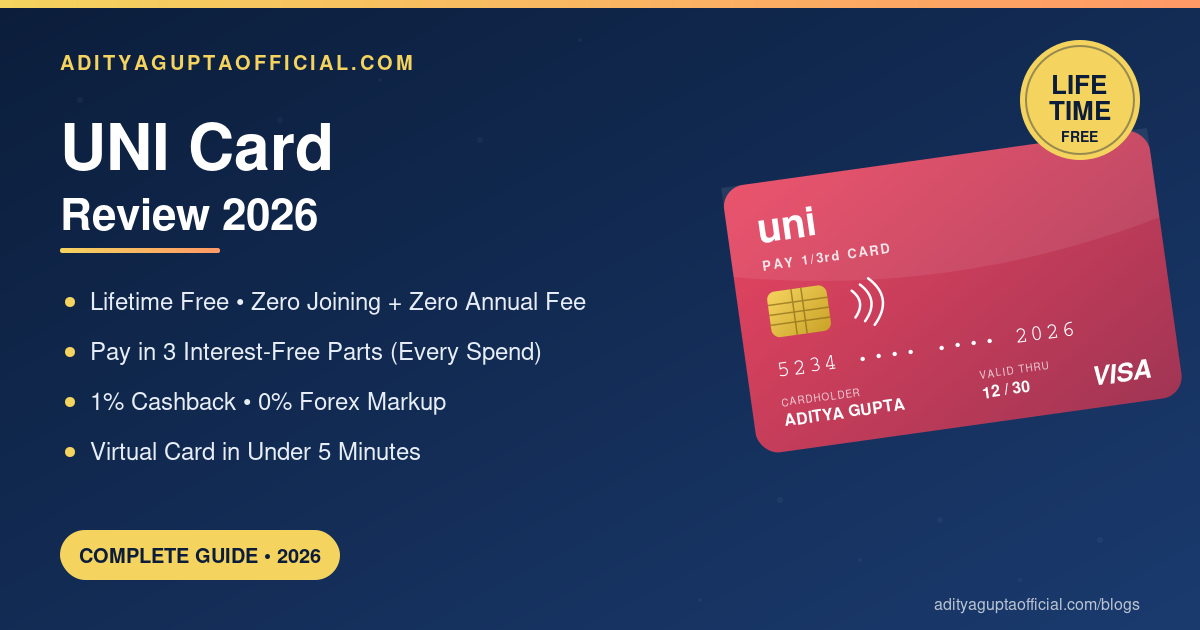
UNI Card Review 2026 — Pay 1/3rd, 1% Cashback & Lifetime Free Credit Card Explained
Most credit cards in the country quietly extract ₹500 to ₹3,000 from you every year just for the right to keep a piece of plastic in your wallet. They dress this up as a “joining fee” and a “renewal fee”, then layer on welcome benefits that conveniently expire before the fee is even paid back. For the first-time card user, the salaried professional with no taste for fine-print games, or the freelancer who likes flexibility on monthly cash flow, the offer is rarely worth the hassle.
The UNI Card is built around the opposite proposition. There is no joining fee, no annual fee for life, no interest on its signature Pay 1/3rd splits, a flat 1% cashback when you settle in full, and zero foreign exchange markup on the latest variant. This guide walks through everything an Indian consumer needs to understand about the UNI Card — what it is, how it works, what it costs, who it suits, and how to apply in under five minutes. Each section can be read on its own, but together they form the complete picture.
1. What Exactly Is the UNI Card?
The UNI Card is a fintech-issued Visa credit card offered by Uniorbit Technologies Private Limited in partnership with SBM Bank India. Earlier variants were also issued through RBL Bank, but the current flagship product — marketed as UNICARD and Uni Pay 1/3rd Card — sits under SBM. The card runs on the Visa network, which makes it acceptable at over 99.9% of merchants that take any credit or debit card in the country.
Structurally, it functions like a regular credit card — you get a credit limit, a monthly bill, a due date, and the ability to swipe or tap anywhere Visa works. Behaviourally, it adds the convenience of a Buy Now Pay Later product on top — you can split any month’s bill into three or two equal interest-free installments without invoking any merchant-specific EMI scheme. The entire experience, from application to KYC to spend controls to statements to support, lives inside the UNI Card mobile app. There is no paperwork, no branch visit, no salary slip submission.
If you want the short version: it is a lifetime-free credit card that doubles as a universal no-cost-EMI tool, run through a clean mobile app.
Application is fully digital. Virtual card is ready instantly. Physical Visa card is delivered in 5–7 working days.
Get Your UNI Card →2. The Headline Feature — Pay 1/3rd Explained
The single feature most people associate with the UNI Card is its Pay 1/3rd mechanism. It is also the easiest one to misunderstand, so it is worth slowing down.
Suppose you spend ₹30,000 on the card in a month. On the bill date, you have two choices. You can pay the full ₹30,000 by the due date — in which case you earn 1% cashback, or ₹300 credited back to your card. Or you can split the bill into three equal parts of ₹10,000 each, payable over the next three monthly cycles. No interest. No EMI processing charge. No “convenience fee”. The card simply spreads the bill across 90 days at zero cost.
The reason this matters is that most traditional credit cards offer no-cost EMI only on specific merchant tie-ups — a particular phone on a particular e-commerce site for a particular tenure. UNI offers the same benefit on every spend, with no merchant precondition. Cash flow stays smooth even if a single month’s spending is unusually high.
There is also a Pay 1/2 variant that splits the bill into two equal installments instead of three, for users who prefer a tighter payment cadence. The interest treatment is identical — zero.
3. Fees, Charges, and the Free-Forever Math
The fee structure is the most attractive part of the proposition, and it is also where the small print matters.
Joining fee: Zero. Annual fee: Zero, for life. Renewal fee: Zero. Interest within the 3-month free window: Zero. Forex markup on the new UNICARD: Zero. These are the line items that earn the card its “lifetime free” tag.
Carry-forward fee: Up to 5.5% per month on the unpaid portion if you extend repayment beyond the free credit window. This is the fee that replaces traditional credit-card interest. It only applies if you intentionally roll over a balance past three months.
Late payment fee: Slab-based on bill amount. This is one area where UNI is noticeably harsher than the average bank-issued card. A missed due date can sting. The defensible workaround is to set up a UPI auto-pay or a calendar reminder on the day the card arrives — pay on time and you spend exactly nothing on the card all year.
Minimum amount due: 7.5% of the total bill, paid by the due date, keeps the account current. GST: Applicable on fees at the standard government rate.
The practical implication is straightforward. If you pay your bill in full or split it within the three-month window, the card is genuinely free — no fee will ever hit your statement. The only way to incur a cost is to miss a payment or to carry forward past the free window. Both are within your control.
4. Eligibility, KYC, and the 5-Minute Application
The eligibility criteria are deliberately permissive. The minimum age is 18 years; salaried applicants can apply up to age 60, and self-employed applicants up to 70. Applicants must be Indian residents and Indian tax residents. There is no fixed minimum-income threshold — the credit limit is derived from your credit profile rather than gated by a hard income floor.
The credit limit ranges from ₹20,000 at entry to ₹6,00,000 at the top end. The exact figure is determined by your CRIF credit score and your demonstrated repayment behaviour. First-time card users with no existing credit history are often approved at the lower end of the band; cardholders with disciplined repayment can request a credit-limit hike inside the app after a few cycles.
The documentation requirement is minimal. You need an Aadhaar card linked to a mobile number (used for OTP-based KYC), a valid PAN card, and that is essentially it. No salary slip, no Form 16, no bank statement, no physical signatures.
The application itself is built for speed. Download the UNI Card app from the Play Store or App Store, enter your mobile number, verify with the OTP, key in your PAN, name as on PAN, and date of birth. The app pulls your credit report from CRIF and presents your eligible credit limit on screen. Accept the terms and conditions, and the virtual card is generated inside the app the moment you tap “confirm”. You can use it for online purchases immediately. The physical Visa card is printed and dispatched within 5–7 working days, typically arriving in a clean welcome kit.
5. Rewards, Cashback, and the 1% Rule
UNI’s reward design is intentionally simple — perhaps too simple if you are chasing maximum value, but refreshingly transparent.
The headline benefit is a flat 1% cashback on the full bill amount, credited only when you pay the entire bill within the due date. There is no spend category gating, no points-to-cashback conversion ratio, no exclusion list buried in the terms. Whatever you spend, paid in full, returns 1% as cash.
The trade-off is explicit. If you opt to split your bill across three months — the card’s headline flexibility feature — you forfeit the cashback for that cycle. The 1% reward is the issuer’s way of recognising the cardholder who funds the entire bill on time. Splitting and earning cashback in the same cycle is not allowed.
Beyond the base cashback, the issuer periodically runs partner offers through the Uni Store inside the app — bonus discounts at select merchants in food delivery, online shopping, and bill payments. These are rotational, modest in size, and best treated as occasional sweeteners rather than the primary reason to hold the card. The fundamental value proposition remains the structural one — lifetime free plus no-cost EMI on every spend.
6. UNI Card vs Traditional Credit Cards
Comparing the UNI Card against a typical entry-level bank-issued credit card surfaces both its strengths and its limitations.
Joining and annual fees. Most entry-level cards charge ₹250 to ₹1,000 as a one-time joining fee and ₹500 to ₹3,000 annually thereafter, often waived if you cross a certain spend threshold. UNI charges nothing on either count, and the waiver does not depend on hitting a spend target.
No-cost EMI. Traditional cards offer no-cost EMI only on specific merchant promotions — usually large electronics retailers and specific product SKUs. UNI offers the same benefit on every spend, with no merchant gating.
Cashback design. A category-rich cashback card (5% on dining, 2% on online shopping, and so on) can outperform UNI’s flat 1% for a heavy and well-targeted spender. For the average user who simply wants something back on every transaction without optimising spend categories, the flat 1% is easier to capture.
Onboarding. Bank-issued cards take 5–10 days from application to card-in-hand, with paperwork, physical KYC, and sometimes a sales-agent visit. UNI is fully digital — virtual card in minutes, physical card in a week.
Forex markup. Traditional cards charge 3% to 3.5% on international transactions. The new UNICARD applies 0%, which materially changes the economics of any USD-denominated online subscription.
What traditional cards do better. ATM cash withdrawal works on a bank credit card; not yet on UNI. Reward redemption ecosystems are richer on premium bank cards — airport lounge access, milestone benefits, complimentary insurance, voucher catalogues. If those benefits matter to you, the UNI Card complements rather than replaces a primary premium card.
7. Smart Ways to Use the UNI Card
A few patterns make this card materially more valuable than the average wallet warmer.
Use it for big-ticket purchases. A new phone, a laptop, a refrigerator, an annual home insurance premium — anything large enough to feel inconvenient in a single hit becomes painless when split into three. No interest, no merchant precondition, no separate application.
Use it for international subscriptions. ChatGPT Plus, Netflix Premium, Spotify Family, Notion, Steam game purchases, AliExpress orders — anything billed in USD on a recurring basis. The 0% forex markup saves you about 3.5% on every renewal compared to a standard credit card.
Set up UPI Auto-Pay the day the card arrives. The single biggest risk on this card is the late-payment fee. Auto-pay on the due date removes that risk permanently. You can still pay manually if you want to fine-tune the split, but the safety net is in place.
Pair it with a category-cashback card. Run groceries, fuel, and dining through the cashback card that gives you 3–5% in those categories. Run everything else — the long tail of subscriptions, online shopping, and one-off purchases — through UNI for the flat 1% and the flexibility to split if needed.
Use the virtual card for trial subscriptions. Many free trials auto-convert into paid subscriptions if you forget to cancel. Use the in-app card-freeze toggle the moment you cancel — the card is locked instantly with a single tap, and no further charges can land. Unlock with another tap when you want to use it again.
8. Who Should Get It — and Who Should Stay Away
The UNI Card is a strong fit for a specific kind of consumer, and a poor fit for others.
Strong fit. Young salaried professionals tired of paying ₹2,000 every year to keep a card alive. First-time card users above 18 looking to build a credit score on a low-risk product. Freelancers and gig workers with lumpy monthly income who benefit from being able to smooth a high spend across three months. Subscription-heavy users with a meaningful share of USD-denominated recurring payments. Anyone who wants a back-up no-cost-EMI card in the wallet without committing to a fee.
Poor fit. Consumers who routinely miss payment due dates — the late fees will erase the structural savings. Heavy reward chasers who already have a category-optimised cashback card delivering 3–5% on most spend. Frequent ATM cash users — UNI does not support ATM withdrawals at present.
For most readers in the first list, the UNI Card belongs in the wallet as either the primary or the secondary card. The cost of carrying it is genuinely zero, so the only reason not to apply is if you actively know you will mismanage the due date.
No joining fee. No annual fee. Virtual card ready in 5 minutes. Using the referral link below supports the free guides on this blog at no extra cost to you.
Apply for the UNI Card →Frequently Asked Questions
Is the UNI Card a credit card or a Buy Now Pay Later product?
Both, in a sense. It is structurally a credit card issued by SBM Bank India on the Visa network, but it behaves like a BNPL product because of the Pay 1/3rd and Pay 1/2 features. You get the legal protections and acceptance of a credit card, with the cash-flow flexibility of a BNPL line.
Is the card really lifetime free?
Yes. The joining fee is zero and the annual fee is zero, permanently. Charges only apply if you carry forward beyond the three-month free window or miss a payment due date.
Will applying for the UNI Card affect my credit score?
The app performs a soft credit pull using CRIF data when computing your eligible limit. A hard inquiry is recorded only when you formally accept the card. Using the card responsibly — paying on time, keeping utilisation moderate — will help build your credit history over time.
What is the minimum age and income to apply?
The minimum age is 18 years. There is no fixed minimum-income threshold; the credit limit is determined by your credit profile, not a hard salary floor.
Can I withdraw cash from an ATM using the UNI Card?
No. ATM cash withdrawals are not currently supported. The card is built for spends, not for cash.
Can I use the UNI Card internationally?
The new UNICARD (Visa) supports international online transactions with a 0% forex markup. Older variants did not support international transactions; if you are unsure which variant you hold, the app’s “card details” page lists the international-usage toggle.
How long does the physical card take to arrive?
Five to seven working days in most metros. The virtual card inside the app is usable immediately after approval, so there is no waiting period for online spending.
What happens if I miss a payment?
A slab-based late-payment fee is applied to the bill. No compounding interest is charged within the original three-month free window, but the late fee itself can be steep relative to other cards. Setting up UPI Auto-Pay on the due date is the easiest permanent fix.
The Bottom Line
The UNI Card occupies a specific position in the credit-card market — not the highest-rewarding card a household can carry, not the most premium, but among the very best at the boring, structural job of being free and useful. The combination of lifetime-free pricing, true no-cost EMI on every spend, a flat 1% cashback for the bill-in-full crowd, and zero forex markup on international transactions makes it one of the cleanest value propositions in the entry-to-mid segment in 2026.
For the first-time cardholder building credit history, the salaried professional tired of fee waivers tied to arbitrary spend thresholds, the freelancer needing month-to-month cash-flow flexibility, and the subscription-heavy user paying in dollars, the card is a near-default addition to the wallet. The discipline cost is low — pay on time, and the structural cost is genuinely zero. The reward cost is also low — flat 1% won’t make anyone rich, but it returns more than most users get from a card that charges them ₹2,500 a year.
If your financial life rewards clean defaults over complicated optimisation, the UNI Card is one of those clean defaults worth holding.
This article is for educational and informational purposes only and is based on publicly available information as of 26 May 2026. Card features, fees, eligibility thresholds, and partner-bank arrangements can change at the issuer’s discretion through periodic policy updates. Please read the Most Important Terms and Conditions (MITC) on the UNI Cards official website and any in-app disclosures before applying. This post contains an affiliate referral link — if you choose to apply through it, the author may earn a small referral reward at no additional cost to you.